Sunday, 28 May 2017

Addressing A New Paradigm: Infectious Diseases And National Security

“If it creates instability, chaos, conflict and war, that has national security implications.” – Samuel R. Berger

Conventionally, national security has been defined as the safeguarding the state from physical threats. The last two or three decades have seen sharp rise in other non-traditional threats, such as drugs, and diseases. Emerging and re-emerging infectious diseases, and their pandemic potential, pose a challenge to national security in the 21st century that cannot be overlooked. The historical threat to national security by epidemic diseases is not new; however the threat has increased in recent past and is growing rapidly in developing countries like Pakistan. There are many lines of attack that infectious diseases can intimidate national security i.e. increased rates of morbidity and mortality, massive damage on public health and health infrastructure, political instability, and economic volatility.
The world has changed noticeably ever since World Health Organization (WHO) issued its first set of legally binding regulations aimed at preventing the international spread of disease. At that point in time, the disease situation was quite stable, new diseases were rare and drugs had transfigured the care of many recognized infectious diseases. However, today’s vastly itinerant, interdependent and interconnected world provides innumerable opportunities for the quick stretch of infectious diseases and toxic threats. Infectious diseases are now spreading geographically much faster than at any time in history and currently are the second leading cause of death worldwide and the leading cause of morbidity. Roughly, there are now nearly 40 to 50 diseases that were unknown a generation ago and disease outbreaks – whether natural, accidental or deliberate in origin, are an increasingly salient national security concern.
Historically, literature on health and security has been scarce and only in the past few years a body of literature on health and security has emerged. At the nexus of health and security lie many poignant examples of the growing threat of biological weapons, the negative impact of naturally occurring infectious diseases, the migration and proliferation of emerging and reemerging infectious diseases to non-endemic areas that fabricate a strong case for including health concerns in the national security debate. Though, health and security have traditionally occupied separate domains, in recent years the imperative fusion between health and national security has been recognized by policymakers, security and defence analysts in both developed and developing countries. Conversely, many medical innovations and technologies currently used in emergency rooms and operating theatres have military origins. Breakthroughs in surgery, trauma care, circulatory access, prosthetics and rehabilitation have come from the field of battle or military R&D.
In Pakistan, the emergence and re-emergence of Chikungunya in Sindh province and spread of Chickenpox in Punjab province along with the dispersion of infectious diseases geographically throughout country demonstrate that Ministry of Health (MoH) and Ministry of Defence (MoD) are not incorporated and interconnected to address the national health and security issues. Likewise, research and development (R&D) for new tools and technologies to prevent, detect and respond to emerging disease threats and outbreaks have not been considered with growing need in the country. As seen with the Chikungunya and Chickenpox outbreaks, there is a shortage of appropriate diagnostics and vaccines to manage the response and lack of regulatory framework for fast-tracking and surveillance technology, tools and techniques when respond is indispensable.

To cut a long story short, the link between infectious diseases and national security is relatively a new concept in Pakistan. A new paradigm is needed that link infectious diseases to national security and recognize the broad effects of diseases on our society. Response to infectious disease threats should be strategic priority of health and security agencies. Ministry of Defence (MoD) needs to acknowledge its role in ensuring that the state’s population is fit and healthy since there are no signs that the Ministry of Defense (MoD) is awakening to this responsibility. At a time when our conceptions of national security are evolving rapidly, we must look hard at uncertain and non-traditional threats, exceptionally. With uncertainty and ambiguity, a large amount of work is needed to bring analytical clarity to the health and national security paradigm.

Wednesday, 17 May 2017

Technopolitika: Science & Technology In International Relations

Science and technology (S&T) are at the same time symbol and engine of modernization. They are therefore subjects of importance and controversy for developing countries. Science is valued for its close relationship to technology and shorthand phrase “Science & Technology” has become so embedded in the vernacular of international relations that it is almost impossible to avoid. As said by Alfred Thayer Mahan, “In a globalized world economy, whoever has the technological edge will dominate the world.”

In international relations, S&T, economics and diplomacy are the most important tools for any nation. Historically, S&T has been one of the main currencies for exchange and dialogue among human societies and sovereign nations. In modern times, it is emerging as an important instrument of techno-economic power that will shape the changing dynamics of international relations. For every sovereign nation both S&T and diplomacy are essential tools for managing international relations, the essence of which is protecting national security and projecting national power. More recently, S&T has not only been effectively used by nations for soft-power projection and establishing the power-balance dynamics between sovereign nations but also, offering unconventional channels of engagement amongst countries that may have political differences. In this changing paradigm, it is highly desirable to understand the importance of S&T dimensions of international relations and the changing dynamics of diplomacy among nations.

In recent past, economic globalization and volatile escalation of Information Communication Technology (ICT) has subjugated the political and corporate agenda that is defining a new prototype where competition and cooperation must coexist among most sensible societies and nations. This will call for skilful ambassadorial strategy of different priorities in future that will have to be based on sound understanding of the role of S&T in international relations. Our world is far more interconnected today, where no nation can afford to be isolated, no matter how powerful or self-sufficient. Technologies of global reach are changing the reference lines and timelines of the geopolitics of international relations, diplomatic perceptions and global affairs.

Since independence, S&T development in Pakistan has been need-based and not really driven by any ‘National Action Plan’. Pakistan also performed very poorly in implementing the National Science, Technology and Innovation Policy (ST&I) 2012 and Science, Technology & Innovation Strategy 2014-18. While there have been many pockets of excellence in scientific research and technology innovation, the nation as a whole still fares rather poorly in S&T in comparison to most other comparable nations. As a result, there are no long-term plans for synchronizing S&T development or technology acquisition with the objectives of foreign policy or diplomatic agenda. Considerably, the government, S&T specialists and foreign policy makers may perform the following role:

  • ·         Government must get its own house in order; leaders should exhibit good moral character and exceptionally eliminate corruption and nepotism from ST&I Policy and from society as-a-whole.
  • ·         Establish the coordinating office for S&T based foreign policy and clear position to science and technology diplomacy (STD) as the new axis.
  • ·         Utilize science and technology personnel in diplomatic activities/missions and scientific knowledge in formulating and implementing diplomatic policy.
  • ·         Promote strategic joint research and development with partner countries with high diplomatic importance.
  • ·         Strategically target influential S&T related organizations and promote intellectual exchange. Set a diplomatic agenda based on scientific evidence, and lead international efforts.
  • ·         Proactively convey the message that Pakistan will take leadership role for the solution of global challenges by using S&T to achieve desirable international circumstances.
In the modern world of today, S&T is so intimately rooted in national priorities and international equations that it has become an inseparable component of international relations. In the future, S&T will play a role greater than any other factor in shaping relations among nations. Science and technology diplomacy (STD) will not only play the final defining role but also a central role in building and strengthening relationships with other countries. Today is high time for the scientists, scientific and technological communities of Pakistan to play a progressively more visible and critical role as knowledge brokers, creators and disseminators. In these efforts, science and technology diplomacy can and should be central to each of our nations’ focus on foreign policy and our role in the world.


Saturday, 4 March 2017

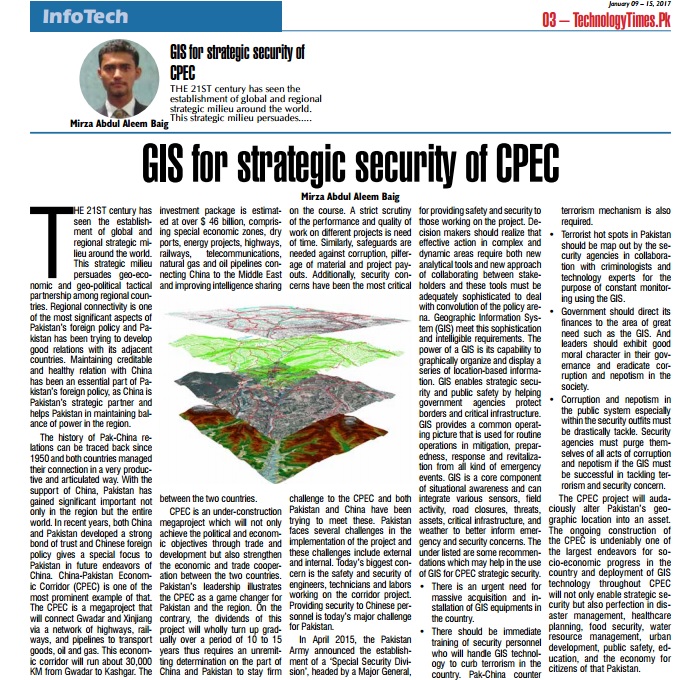
GIS for strategic security of CPEC

THE 21ST century has seen the establishment of global and regional strategic milieu around the world. This strategic milieu persuades geo-economic and geo-political tactical partnership among regional countries. Regional connectivity is one of the most significant aspects of Pakistan’s foreign policy and Pakistan has been trying to develop good relations with its adjacent countries. Maintaining creditable and healthy relation with China has been an essential part of Pakistan’s foreign policy, as China is Pakistan’s strategic partner and helps Pakistan in maintaining balance of power in the region.

The history of Pak-China relations can be traced back since 1950 and both countries managed their connection in a very productive and articulated way. With the support of China, Pakistan has gained significant important not only in the region but the entire world. In recent years, both China and Pakistan developed a strong bond of trust and Chinese foreign policy gives a special focus to Pakistan in future endeavors of China. China-Pakistan Economic Corridor (CPEC) is one of the most prominent example of that. The CPEC is a megaproject that will connect Gwadar and Xinjiang via a network of highways, railways, and pipelines to transport goods, oil and gas. This economic corridor will run about 30,000 KM from Gwadar to Kashgar. The investment package is estimated at over $ 46 billion, comprising special economic zones, dry ports, energy projects, highways, railways, telecommunications, natural gas and oil pipelines connecting China to the Middle East and improving intelligence sharing between the two countries. 

CPEC is an under-construction megaproject which will not only achieve the political and economic objectives through trade and development but also strengthen the economic and trade cooperation between the two countries. Pakistan’s leadership illustrates the CPEC as a game changer for Pakistan and the region. On the contrary, the dividends of this project will wholly turn up gradually over a period of 10 to 15 years thus requires an unremitting determination on the part of China and Pakistan to stay firm on the course. A strict scrutiny of the performance and quality of work on different projects is need of time. Similarly, safeguards are needed against corruption, pilferage of material and project payouts. Additionally, security concerns have been the most critical challenge to the CPEC and both Pakistan and China have been trying to meet these. Pakistan faces several challenges in the implementation of the project and these challenges include external and internal. Today’s biggest concern is the safety and security of engineers, technicians and labors working on the corridor project. Providing security to Chinese personnel is today’s major challenge for Pakistan. 

In April 2015, the Pakistan Army announced the establishment of a ‘Special Security Division’, headed by a Major General, for providing safety and security to those working on the project. Decision makers should realize that effective action in complex and dynamic areas require both new analytical tools and new approach of collaborating between stakeholders and these tools must be adequately sophisticated to deal with convolution of the policy arena. Geographic Information System (GIS) meet this sophistication and intelligible requirements. The power of a GIS is its capability to graphically organize and display a series of location-based information. GIS enables strategic security and public safety by helping government agencies protect borders and critical infrastructure. GIS provides a common operating picture that is used for routine operations in mitigation, preparedness, response and revitalization from all kind of emergency events. GIS is a core component of situational awareness and can integrate various sensors, field activity, road closures, threats, assets, critical infrastructure, and weather to better inform emergency and security concerns. The under listed are some recommendations which may help in the use of GIS for CPEC strategic security.
There is an urgent need for massive acquisition and installation of GIS equipments in the country.
There should be immediate training of security personnel who will handle GIS technology to curb terrorism in the country. Pak-China counter terrorism mechanism is also required.
Terrorist hot spots in Pakistan should be map out by the security agencies in collaboration with criminologists and technology experts for the purpose of constant monitoring using the GIS.
Government should direct its finances to the area of great need such as the GIS. And leaders should exhibit good moral character in their governance and eradicate corruption and nepotism in the society.
Corruption and nepotism in the public system especially within the security outfits must be drastically tackle. Security agencies must purge themselves of all acts of corruption and nepotism if the GIS must be successful in tackling terrorism and security concern.

The CPEC project will audaciously alter Pakistan’s geographic location into an asset. The ongoing construction of the CPEC is undeniably one of the largest endeavors for socio-economic progress in the country and deployment of GIS technology throughout CPEC will not only enable strategic security but also perfection in disaster management, healthcare planning, food security, water resource management, urban development, public safety, education, and the economy for citizens of that Pakistan.

Wednesday, 22 June 2016

‘War on Corruption’ – The Anti-Corruption Cooperation in SAARC Countries!


The South Asian Association for Regional Cooperation (SAARC) was formed in December 1985 with seven member states: Bangladesh, Bhutan, India, Maldives, Nepal, Pakistan and Sri-Lanka. Whereas, Afghanistan became the eight member in 2007. SAARC is the regional organization at the government level for the 8 member countries to delineate their differences and promote welfare of the people, improve quality of their life and accelerate economic growth. Since its establishment, SAARC is focused on promoting economic cooperation and growth, mutual assistance in the social, cultural, technical & scientific fields, and the rule of law. SAARC ultimately aims to provide a platform for cooperation and dialogue among the governments of South Asia. Since, South Asia is at a crossroads powered by the vibrant development and fastest-growing region in the world and it can be squeezed faster to find its equitable place in the world. If its member states develop as an incorporated economy this would make South Asia the second-largest economy in the world.
On the contrary, no country is free from the threat of instability whether caused by terrorism, economic-terrorism, bad governance and regional security. Similarly, problems such as corruption, backwardness, poverty, illiteracy, high rate of crime, etc, create sagacity of insecurity among all the member states of South Asia. There have been moments of significant coming together among SAARC states on rule of law issues, particularly drug trafficking, anti-terrorism, anti-corruption, cyber-crime, which are major security challenges for South Asia. South Asian countries do not only rank ill in governance standards but also, poor infrastructure together with defensive policies, corruption and red tape, are key barrier that impede the economic growth of these countries. Even though they have individually launched programs to fight corruption and improve public sector and governance but, every day stories covering issues of corruption appear in South Asian print and electronic media telling stories of corruption, corrupt officials, money laundering, and abuse of power – crimes that propagate political and regional instability.
In recent times, a strong global consensus has emerged that addressing corruption and building good governance is essential for the development of people and economic prosperity of any country or region. Despite the fact, SAARC faces severe challenges in bonding such a diverse region with different political, social and religious traditions. Regardless of lack of common grounds, it is crucial that SAARC countries put aside their difference and work to fabricate common solutions to the problems they are facing in their economic and regional development, as well as rule of law and menace of corruption. The 19th South Asian Association for Regional Cooperation (SAARC) summit will be held in Islamabad, Pakistan in November, 2016. While speaking at a conference of the States Parties to the United Nations Convention Against Corruption (UNCAC), in Saint Petersburg, Russia, Chairman National Accountability Bureau (NAB) Pakistan, Qamar Zaman Chaudhry said that a regional conference of SAARC member countries on anti-corruption will be hosted by Pakistan to promote bilateral and regional cooperation on anti-corruption issues. In view of the desire of the government of Pakistan the following steps are recommended as the way forward for SAARC countries to combat corruption in the region;
  • ·         Governments of SAARC countries should have a zero tolerance for corruption and money laundering in their countries.
  • ·         Governments of SAARC countries should educate and involve citizens in building integrity to prevent corruption. Punish the corrupt and support those who have suffered from institutional corruption.
  • ·         Governments of SAARC countries should conduct public-education and awareness-raising activities, integrity-building workshops, and other cross-border events to eradicate corruption and poverty.
  • ·         Governments of SAARC countries should reform the justice systems by ensuring very stiff and stricter penalties for people found guilty of corrupt practices.
  • ·         Governments of SAARC countries should establish a closer link and develop a network of dedicated individuals committed to the objective of ending corruption.
  • ·         Governments of SAARC countries should apply the principle of consensus in the allocation of natural resources to prevent regional conflict and use dialogue as a tool of settling regional problems such as insecurity, insurgency, corruption and poverty.
In a nutshell, SAARC has made significant progress in improving socio-economic development and scientific & technological coordination in South Asia. It is now time for it to shift its focus to other, long-standing political, good governance and anti-corruption concerns. SAARC should therefore play an important role in helping member state governments meet their citizens’ demands; this action would contribute to building regional peace, stability and economic prosperity.


Friday, 29 April 2016

Scientization of democracy – the science & policy nexus

“Unless scientists and policymakers learn to work together effectively, both domains will suffer.” – Lewis M. Branscomb

What role does science play in the government? What is the role of science in relation to policymaking? Democratic societies make policies and decisions based on various inputs, including, economic considerations, societal standards, general public views, and the principles and vision of the government of the day. As we enter the 21st century, policy making is taking place in a decidedly dynamic environment. The emergence of the knowledge-based society has emphasized the significance of sound ‘Science Advice’ as a key input to policy formulation. In an environment which is persistently becoming more complex, ministers, member of parliaments and other policymakers are anticipated to presume scientific evidence and judgment when designing policies.

Whatever the issue may be – pressure on the supply of energy, food and water, health, security, climate change, genetically modified crops, biological and chemical weapons, biosafety and biomedicine, cybercrime, cyber-terrorism, civil use of nuclear power – scientific expertise present an elemental root for policymaking. Science-based policymaking has grown ever more significant in recent years alone with the dramatic increase in the complexity and uncertainty of the ways in which science and technology interact with society. As the world around us becomes increasingly complex, disruptive technologies and social innovations are changing our way of life at an accelerating speed, and policymaking is not immune to this. Therefore, decision-making increasingly depends on advice given by science and technical experts in order to deliver the most innovative and effective policies.
Thanks to modern information and communication technologies, evidence can now be delivered in real time and from a multitude of sources. This also creates new opportunities for the involvement of citizens in policymaking. Scientific advice plays an important role in the development of policies is most developed countries. In Pakistan, scientific experts should be involved in providing advice not only on S&T but also, regulatory or general policies. Since, policymakers require sound scientific information if they are to make decisions. In this regards, the government may perform the following roles:
  • Government should establish effective mechanisms for ensuring appropriate and timely scientific advice and define clear and transparent frameworks and rules of procedure for their advisory processes and mechanisms.
  • Government should implement measures that build societal trust in science for policymaking and work with international organizations to ensure coherence between national and international scientific advisory mechanisms related to complex global challenges.
  • Government should take a strategic approach to the prioritization, accessing, resourcing and delivery of science and technology and ensure effective knowledge transfer.
  • Government should continue its efforts to strengthen good governance, with the emphasis on scientific development and give priority to fight against corruption and nepotism throughout National ST&I policy.
Indeed, science in an extensive array of fields is genuinely built into the everyday operations of today’s government. Science-based policymaking has grown ever more important in both developed and developing states, since, living standards, employment and quality of life depend progressively on the exploitation of investment in scientific knowledge. The rapid developments of the modern world in regard to technical and technological capabilities results in a particularly high demand for well-informed political decision-making. Likewise, people rightly expect politicians to be honest with facts when they decide about public policies and future scenarios. Consequently, in Pakistan, there is an escalating obligation from policymakers for science advice because scientific evidence may help to manage risks and facilitate them to formulate better and effective regulatory and legislative decisions. This is why scientific knowledge and evidence is an essential prerequisite in policy processes, and policy makers must duly respect advice from scientific community. Installing a proper framework for ensuring the integrity and trust in science is becoming an urgent task for policymakers in country. In doing so, it will add not only to the history of ingenuity but also to the thoughts of democratic system.

Thursday, 31 March 2016

Health Diplomacy – advancing health & foreign policy

“Health is today a growing concern in foreign policy” – Dr. Margaret Chan

Health is on the radar of foreign policy since it is connected to three global agendas i.e. security, economy, and social justice. Over the past decade, countries around the world have progressively acknowledged the significance of linking their foreign policy efforts and their work on health. Various events around the globe have contributed to the development of the field of “Health Diplomacy”, for instance the increase in global funding to fight HIV/AIDS, the treat of emerging and re-emerging infectious diseases, the need for virulent disease vigilance, fears about bioterrorism, and emerging focus on health system strengthening and universal health coverage.
In recent times, there has been an astonishing surge of interest in the topic of health diplomacy. It is worth noting that, even with this growing level of interest, there is modest accord on how to define health diplomacy. The notion of health diplomacy was introduced as early as 1978 by Peter Bourne, special assistant to the president for health issues during the Jimmy Carter administration. He argued that “the role of health and medicine as a means for bettering international relations has not been fully explored by the United States. Certain humanitarian issues, especially health, can be the basis for establishing a dialogue and bridging diplomatic barriers because they transcend traditional and more volatile and emotional concerns”.
As a developing country, Pakistan has largely been the recipient of various developmental aids from developed countries including that for health and also relied on such assistance to advance domestic health condition. Conversely, with its escalating national power, Pakistan is also anticipated to shoulder responsibilities and to make contributions to many other developing countries of the region, not just in the form of medical teams. As the 21st century continues to emphasize the need for synchronized health actions between nations, the significance of health diplomacy has become obvious within foreign policy loop. Pakistan must have bilateral or multilateral health treaties and agreements with other countries through multi-year action plan, with particular emphasis on health system development, public health, prevention of disease, primary health services and global health.
In the modern globalized world today, health is too important and political to be left only to the ministry of health. Globalization requires that ministers of health act with other countries in order to ensure the health of the residents at home. In this regard the government should:
  1. ·         Integrate a global health perspective into its general foreign policy and create an information platform for health diplomacy,
  2. ·         Harmonize general foreign policy and other policies to highlight the health effects of foreign policy, and improve the promotion of public health nationally and globally,
  3. ·         Establish the coordinating office for health foreign policy to highlight the connection between health and well-being, social development and security,
  4. ·         Produce policy papers on subjects arising in health foreign policy and strengthen academic proficiency,
  5. ·         Continue its efforts to strengthen good governance, with emphasis on institutional development and the rule of law,
  6. ·         And, give priority to fight against corruption and nepotism throughout development and foreign policies, with targeted efforts in the health diplomacy.
It is an eminent fact that health is a global public good and national public health cannot be safeguarded by any state in isolation. Almost all world leaders have committed themselves to ensuring that all individuals enjoy the right to health. They have also agreed to cooperate to realize this right for people all over the world. In Pakistan, foreign policy must take health issues into account, and health issues must have a diplomatic dimension. Foreign policy practitioners need to become aware of impact of policy options and decisions on health outcomes and must back these words with their actions. This is how foreign policy can make a difference to health and this is a task by which they are likely to be judged by future generation.


Thursday, 10 March 2016

Who will rise against corruption?

In his historic speech delivered to the first Constitution Assembly of Pakistan on 11th August 1947, Mohammad Ali Jinnah identified the first duty of his government as the maintenance of law and order and defined his second priority in the following words:  “One of the biggest curses from which India is suffering is bribery and corruption. That really is a poison. We must put that down with an iron hand and I hope that you will take adequate measure as soon as it is possible for this Assembly to do so.” 
Regrettably for Pakistan, these intelligent words have not been heeded to in the last 68 years and corruption has become a virus infecting every aspect of political, social and economic activities. Corruption and bad governance is not only threatening our national security, economic prosperity but also, international reputation. In Pakistan, bad governance is perceived as widespread and systemic and deeply embedded in society and in government divisions at all levels. Moreover, bureaucratic corruption taking place in public administration at the implementation end of public policies. At this end, citizens experience corruption daily in their dealing with public administrators and services, like education, health, licensing authorities, police, customs, taxing authorities, and many other government agencies.
The recent report of Transparency International (2015) ranked Pakistan (Corruption Perception Index: 117) among the most corrupt countries and corruption has become a multibillion dollar industry. Corruption is a result of poor governance as it is a social epidemic and major constraint to good governance. To protect the democracy from this epidemic, accountability and transparency have become important element of governmental reform. Unfortunately, there is a lack of transparency and accountability in every public sector of Pakistan. In various literatures, corruption has been shown as the result of lack of transparency and accountability which is dangerous for democratic setup. It is also widely accepted and proved that transparency and accountability are major determinants in the fight against corruption. 
Globally, there is an ongoing debate in economics, political science and information technology over the best evaluation methods for transparency and accountability. Innovative technologies are opening up all kind of possibilities for improve and promote accountability and transparency. Information and communication technologies (ICTs) are progressively seen by governments, activists and civil society as an imperative tools to promote transparency and accountability, along with to identify and reduce corruption. There is a comprehensive accord that ICTs have the potential to make a meaningful contribution to the fight against corruption via facilitating the flow of information between government institutions, government and citizens, as well as among citizens. In the modern age, governments around the world are beginning to introduce ICT to the public sector reform in order transform governmental relations with citizens, good governance and curb corruption since new technologies can promote transparency, accountability and citizen participation.
Over the past few years, researchers have increasingly focused on the link between poor governance, corruption, and economic growth. Governance and corruption are multi-dimensional phenomena that affect different sectors and groups of citizens in any country. In Pakistan, cross-country evidence shows how poor governance and corruption may be harmful for standards of living and the distribution of income of citizens, reducing literacy and per capita income, while increasing infant mortality. Moreover, poor governance and corruption distorts public expenditure and increase poverty.
In poorly governed country, policymakers must face the challenge of designing and implementing effective reforms to improve governance and curb corruption. Policymakers need to approach governance and anti-corruption reforms in a novel way and integrate political commitment with technical measures and citizens’ participation. If an anti-corruption policy is to be viable, it must be designed as a multi-pronged venture that comprise a set of multifarious actions in different areas of society and sate institutions. More expressly, there is a substantial need to define all dimensions of the anti-corruption struggle and the role of ICTs can play in it, since ICTs hold the biggest potential for promoting the anti-corruption effort.

Sunday, 6 March 2016

'Fighting the smokeless war' – Who will frame National Cyber Security Policy?

The 21st century is seeing more countries paying attention to asymmetrical threats as a new dimension in strategic defense. Although, traditional security issues will continue into the new century but threats such as terrorism and trans-boundary crime has also attracted attention and is given focus as parts of the national strategic perspective. It is alarming that, in recent years, together with the occurrence of new information and communication technology (ICT) and the development of the internet, new threats have appeared, such as cyber-crime, cyber-terrorism, cyber espionage and cyber-conflicts, with the participation of non-state entities, and cyber war understood as confrontation between countries in the cyberspace.
Current trends in the development of threats in the cyberspace clearly indicate an increasing influence of the level of security of the cyber domain on the general security of the country. The recent development in our region has pointed to a number of new challenges and uncertainties which impact Pakistan’s national defense. Various forms of extremism motivated by political, religious, ethnic or other reasons pose an important challenge for the national security. They are particularly dangerous when they are connected with the use of terrorism.
The rapid evolution of information and communication technology (ICT) is escalating the pace, capability, flexibility, efficiency and effectiveness of the current networks and systems, both within the civil and military scope. Information in conjunction with communication technologies are altering the way in which people interact between themselves and with their environment. This continual and accelerated progression of the ICT has led to cyber attacks becoming more and more sophisticated and numerous, leading to a cyber space that is ever more hostile, forcing those responsible for national and cyber security.
Security, in all its dimensions and spheres, is the first responsibility of any government. The government of Pakistan should assume leadership regarding cyber security in order to make its citizens aware of the need for protecting our cyberspace. Pakistan still does not have a solid capacity allowing the efficient administration, control and management of its cyber security. Therefore, the government and policy makers are accountable for setting the agenda for securing all national security domains including cyberspace. Ideally, the government may perform the following roles:
Characterize of the role of cyberspace in achieving national development goals;
Identify, analysis and mitigation of risks to achieving national interests;
Develop cybercrime/cyber-terrorism legislation that is applicable and interoperable;
Resource national cyber-security programs and institutional capacity building; 
Formulate and defend cyber-security position at regional and global forums. 
In many countries, cyber-security has become a national policy priority supported by loyal and devoted leadership. They are approaching cyber-security in a holistic manner, including, economic, social, educational, technical, law-enforcement, diplomatic, military and intelligence-related aspects. A modern nation-state increasingly depends on cyberspace for its economy, public safety and defense. As a result, establishing a national policy for cyber-security is now and will continue to be an essential and critical element of the overall national security for the government. Another key aspect to bear in mind for the National Cyber Security Policy is the identification of cyber space as the new dimension of the operating environment. It will therefore be compulsory to provide our Armed Forces with cyber capabilities and human, technical and economic resources necessary for their exercise and functions.
There are certain areas of concern regarding the “National Cyber Security Act 2014” introduced in the Senate of Pakistan, for which the following recommendations are put forwarded for consideration in future reviews.
Policy makers must first educate themselves better with respect to the internet, internet and cyber security together with its role in modern society,
Government must get its own house in order and eliminate corruption and nepotism, 
Government must support the necessary R&D to address issues,
Government must overcome the obstacles to realistic, timely, actionable information sharing with industry,
Policy makers must establish a program to educate citizenry about the nature of the problem and alleviation approaches,
Cyber-security policy must be risk-based, outcome-focused, practicable and globally relevant.
To finish, the development of cyber-security policy is a long-lasting dedication for the security and stability of country and its cyberspace, and government must have a voice in international arena in this critical dot.

Saturday, 16 January 2016

Citizen-Centric e-governance: Can Pakistan's democracy be improved?

Information and Communication Technologies (ICTs) have turned into the miracle medicine for curing any country from the diseases of corruption, mismanagement, poor governance, inflation, monopolies, illiteracy and so forth. ICT tools and techniques to support good governance have considerably changed with the appearance of social media, simulation techniques, opinion mining, open government data, text analytics and visualization. Today, people are more connected than ever before through ICT, linked to family, friends, social groups, and increasingly, government. Similarly, ICT tools are empowering to engage with government and find clarity on issues that touch their lives. In developed countries, governments are regarding the call to deliver information in a way that create transparency and demonstrates accountability.
In every sector, information and communications technologies (ICTs) are powerful tools for controlling corruption and ill practices. ICT works principally well when they are embedded in extensive institutional reforms. Generally, ICTs for good governance and controlling corruption operate by shining a bright light upon institutional development. ICTs improve transparency particularly at the transactional level, at the same time offer opportunities for easier access to public records, and establishing linkages among geographically separated structures for better accountability.
In every part of the world from industrialized to developing countries, governments are putting information online to provide better services for citizens and good governance. Globally, there are various countries that are aiming towards refreshing their public administration by making it more proactive, accountable, service-oriented and transparent. This transformation requires intervention of technology in administration and governance, accordingly ICT can play significantly important role in advancement of public sector and its governance. Governments around the world are, therefore, making use of ICT as a standard for promoting Simple, Moral, Accountable, Responsive, and Transparent (SMART) electronic government (e-government). Generally, e-government incorporates three dimensions:
Democratic dimension (e-Democracy): Focusing on the political processes and interaction between the constituents and the government.
Administrative dimension (e-Administration): Including various types of management work, internal and external routines.
Service dimension (e-Service): Relating to the delivery of all types of services.
Participation dimension (e-Participation): To engage with citizens and enable deeper contributions and support deliberative debate on policy issues and to support the democratic decision-making process.
UN member states have recognized broad public participation as an essential prerequisite for the attainment of sustainable development. Public participation always has positive repercussion on good governance and adding the ‘e’ can make good governance better and bad governance worse. Establishing good governance and public participation have become a key concern for sustainable socio-economic development. It has been acknowledged that development cannot take place without sound and capable governance.  
Today, technologies in computing, information system and communication have led to the death of distance and time. Networking technologies work exceptionally fast and can improve anything and everything. Using ICTs to promote, as stated in United Nations Millennium Declaration, “democratic and participatory governance based on the will of the people,” may lead to more responsive and effective government. In a nutshell, democracy, good governance and modernity cannot be imported or imposed from outside a county. Let every forum of policy makers, political leaders and ICT professionals’ converse and fabricate a comprehensive set of recommendations for the successful execution of anywhere-anytime citizen-centric e-Governance across Pakistan.

e-Judiciary - modernizing judiciary with technology

“The future of law is not to be found in impressive buildings or leather bound books but in small pieces of silicon; in streams of light; and in millions of miles of wires and cable.” – Katsh
Technological developments in the meadow of information and communication technology (ICT) and introduction of computers have made a turning point in the history of human civilization. It has brought about a change of tack in all fields of human activity and has resulted in enhanced efficiency, productivity and quality of output in every walk of life. Evolution in technology, particularly the growing use of internet, have created borderless “e-world” and paved the way for irresistible and unmatched changes in every phase of life, including justice. The information and communication technology (ICT) has been advocated in the developed countries for the last two or three decades and this scenario gained astounding thoughts to have technology combined in administration of justice.
ICT has an influential position to play in the modernization of justice, improving efficiency, transparency and effectiveness, and redesigning the judicial process to manage the delivery of justice. The use of ICT in this perspective may not only improve the efficiency and transparency of justice processes but also, enhance the interaction between citizens and public authorities. As a result, the concept of e-Judiciary comes in, and we should also keep in mind that e-Judiciary is not just about “e” or computers. Its basis is judiciary should be primarily concerned with providing justice to the citizens. It should fulfill what justice seekers demand from the system, that is, speedy less expensive, quality, corruption free justice. Principally, e-Judiciary is a process of modernizing judiciary that uses information and communication technology (ICT) for its proceeding to provide justice to people.
Typically, e-Judiciary consists of Case Management System, Information Management System and Court Automation System. This process generally goes this way in order:
•    Registering cases
•    Managing cases
•    Hearing of cases and handling post hearing and report
Judiciary in Pakistan urgently needs re-engineering its course of action, modernize the use of its human resource and bring about change management by harnessing the potentiality of the available information and communication technology to its fullest extent. By using information and communication technology, an effective and efficient system of e-Judiciary can be develop and that system may possibly ensure that judiciary is accessible to all which is trusted by all and it is reliable to all.
The National Judicial Policy 2009 proposes to eradicate corruption and delays from the country’s judicial system, therefore, it is exceptionally significant for Pakistan to have well established e-judicial system on the pillars of speedy and transparent trial system in order to provide fair justice to the people.  Although, Pakistan is a developing country as such, is not yet an advance in ICT innovations, but must not avoid the adoption of electronic method of justice delivery. The electronic methods will not only bring transparency, security of court’s documents but also, swift dispensation of justice. Conversely, the successful implementation and adoption of electronic methods may be challenged by epileptic electric supply, network dysfunction, lack of IT skills, and absence of relevant legal framework. There are many other challenges to implement e-Judiciary in Pakistan as-well i.e.
•    Lack of long term strategy
•    No provision for linking technology with performance
•    No effective planning for the development of skilled HR development in ICT
•    Problems in attitude to manage the change
•    Commitment not to the extent of expectation
Finally, the construction and maintenance of the modern justice system will need extensive preparation and determination. There are already successful precedents in various countries for the use of ICT in judicial system such as European e-Justice (https://e-justice.europa.eu/home.do), European e-Justice Portal (http://ec.europa.eu/justice/criminal/european-e-justice/portal/index_en.htm), Hong Kong Judiciary (http://www.judiciary.gov.hk/en/index/), Indian e-Courts (http://ecourts.gov.in/), Namibia Superior Courts (http://www.ejustice.moj.na/SitePages/Home.aspx) etc. Experience across the developed countries that have embarked on ICT in their justice systems show that ICT tools help to improve and develop the judicial process. For the reason, e-Justice should be a major priority for developing countries like Pakistan. Along with technological developments; institutional and social change within the judicial system should be considered, as well as the harmonization of laws to ICT. Moreover, the whole society has to keep up with the technological development. Social demand is as necessary as effective government determination to improve the administration of justice by ICT.

Science Journalism - building public engagment in science

“I saw on TV…”, “I heard on radio…” and “I read in the newspaper…” are phrases that catch our attention. In the 21st century, the mass media has become the most influential medium that communicates to large numbers of individuals. News is the building block that helps us to construct an understanding of the world we live in, and science and technology (S&T) are principal dynamics in shaping tomorrow’s world. Research and innovation have been acknowledge as key factors in meeting the numerous challenges of our time such as energy supply, food security, health and mobility, environmental changes etc. Being key challenges, public and policy makers must be provided the information that is obligatory to call science and technology to account. For the reason, there is an increasing need of independent science journalism and science communicators to interpret, explain and comment on the results of scientific research and technological development. 
Globally, the public communication of S&T – Science Journalism, is expanding rapidly as a professional and academic field. In developed counties science journalism is accelerating because of advances in information and communication technology (ICT) that facilitates scientific and methodological reporting and scientists are reaching the pubic and policy makers through blogs and social media tools. Momentarily, Pakistan has made a phenomenal progress in S&T and ICT in the past two decades, on the other hand, to what extent the science and scientific knowledge is transmitted to the common masses remains a tricky question in Pakistan?
Science journalism appears to be flourishing in developing counties and journalists are now operating a new science-media ecosystem where scientists and journalists are providing original discoveries directly to the general public instead of going through the official publishing process. Science services made the first sustained effort at gathering and dissemination consistently credible, engaging and understandable news of science and emerging technologies to a nationwide audience through the easily accessible mainstream media. The emerging field of science journalism sought to produce a science-minded public able to appreciate, and willing to support and understand science and technology and scientific research. 
Because of the importance of S&T, it is important that science journalists show how science actually works. That goes beyond just editorials about remarkable expansions in science but includes information about the organizations and funding of scientific research too. Scientific writing or science journalism remains embryonic in Pakistan and there are many dimensions to the problems. Unfortunately the large segments of the population even do not have access to scientific knowledge due to illiteracy and in absence of critically planned science policy for dissemination of scientific knowledge to non-scientific community. Although, Pakistan’s engagement in scientific activities is multiplying and diversifying but, science journalism is very much limited and mainstream media coverage on issues related to S&T is alarmingly poor and limited. Conversely, low priority in science journalism in the mainstream media is also deeply rooted in the country’s journalism history. 
The idea that, to be successful, a technology must meet local needs, conditions and resources for social development. I would say there is definitely a future for science journalism in Pakistan. There is a need for scientific reporting about developments in science and technology, including science policy and science funding. Last but not the least, a multi-prolonged strategy is required to make science journalism effective in our society for that scientific platform should be created to engage scientists and media practitioners to have close discourse on issues relating to scientific and technological developments in Pakistan.

Saturday, 10 October 2015

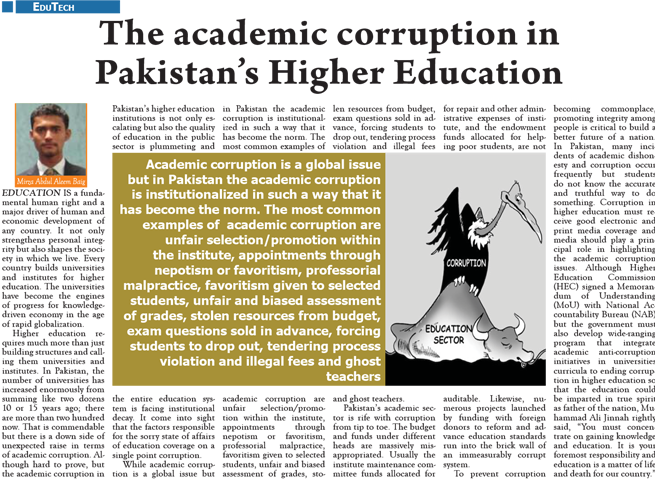
The Academic Corruption in Pakistan’s Higher Education

EDUCATION IS a fundamental human right and a major driver of human and economic development of any country. It not only strengthens personal integrity but also shapes the society in which we live. Every country builds universities and institutes for higher education. The universities have become the engines of progress for knowledge-driven economy in the age of rapid globalization.
Higher education requires much more than just building structures and calling them universities and institutes. In Pakistan, the number of universities has increased enormously from summing like two dozens 10 or 15 years ago; there are more than two hundred now. That is commendable but there is a down side of unexpected raise in terms of academic corruption. Although hard to prove, but the academic corruption in Pakistan’s higher education institutions is not only escalating but also the quality of education in the public sector is plummeting and the entire education system is facing institutional decay. It come into sight that the factors responsible for the sorry state of affairs of education coverage on a single point corruption.
While academic corruption is a global issue but in Pakistan the academic corruption is institutionalized in such a way that it has become the norm. The most common examples of  academic corruption are unfair selection/promotion within the institute, appointments through nepotism or favoritism, professorial malpractice, favoritism given to selected students, unfair and biased assessment of grades, stolen resources from budget, exam questions sold in advance, forcing students to drop out, tendering process violation and illegal fees and ghost teachers.
Pakistan’s academic sector is rife with corruption from tip to toe. The budget and funds under different heads are massively misappropriated. Usually the institute maintenance committee funds allocated for for repair and other administrative expenses of institute, and the endowment funds allocated for helping poor students, are not auditable. Likewise, numerous projects launched by funding with foreign donors to reform and advance education standards run into the brick wall of an immeasurably corrupt system.
To prevent corruption becoming commonplace, promoting integrity among people is critical to build a better future of a nation. In Pakistan, many incidents of academic dishonesty and corruption occur frequently but students do not know the accurate and truthful way to do something. Corruption in higher education must receive good electronic and print media coverage and media should play a principal role in highlighting the academic corruption issues. Although Higher Education Commission (HEC) signed a Memorandum of Understanding (MoU) with National Accountability Bureau (NAB) but the government must also develop wide-ranging program that integrate academic anti-corruption initiatives in universities curricula to ending corruption in higher education so that the education could be imparted in true spirit as father of the nation, Muhammad Ali Jinnah rightly said, “You must concentrate on gaining knowledge and education. It is your foremost responsibility and education is a matter of life and death for our country.” 


Science diplomacy - new mode of foreign policy in the 21st century

HISTORICALLY, foreign policy can be assumed to have emerged when contacts between the earliest human societies took place. It refers to the actions sovereign states take towards each other. It is significant to note that these actions generally are not taken as ends in themselves but are joined in some way to larger principle from long run aspirations to more immediate aims that national leaders hope to achieve in their dealings with other countries.
Sometimes the two terms, foreign policy and diplomacy create confusion. The most appropriate way to distinguish between the two terms is to consider foreign policy as the legislative and diplomacy as the executive phase of the foreign relations of a country. It is believed, foreign policy is an extension of internal or domestic policy and is planned to defend and promote national interests of whom domestic policy is a fundamental part. Often domestic policies have to be made deferential to foreign policy for the reason that without success in foreign policy, there would be no domestic policy left to pursue.
Globally, science and technology is playing a critical role in international affairs, largely through its contribution to technological supremacy. In the well networked world of today, science and technology can play an innovative and positive role in foreign policy issue since S&T serves as a common language and a link amongst peoples when they strive to address both the technical and technological disparities of the 21st century. 
Science and technology are judged by many developed and developing countries to be of essential importance to their national development, not only in terms of intellectual achievement, but also, as an economic driving force. Ultimately, this is reflected in the mounting importance of “Science Diplomacy,” i.e. the building and management of international relations based on science, higher education, and technology. Scientifically developed countries have been active in this arena for decades, now developing like Pakistan are also expressing greater interest in implementing science diplomacy. According to Vaughan C. Turekian (Editor-in-chief of Science & Diplomacy), nations are looking to science to achieve some or all of the three Es of science diplomacy:
a) Expressing national power or influence,
b) Equipping decision makers with information to support policy 
c) Enhancing bilateral and multilateral relations. 
It is necessary to recognize that science diplomacy is not new concept, but factually it has never been given due attention by policy makers in developing countries. The American Association for the Advancement of Science (AAAS) and the Royal Society noted that science diplomacy refers to three main types of activities.
1) “Science in diplomacy” – Science can provide advice to inform and support foreign policy objectives,
2) “Science for diplomacy” – Scientific cooperation can improve international relations, and,
3) “Diplomacy for science” – Diplomacy can facilitate international scientific cooperation. 
It is whispered that Pakistan’s foreign policy is always branded as policy of self-abnegation. It is also blamed that external factors predominantly USA play a central role in the shaping of foreign policy of Pakistan. Paul Kennedy, a famous British historian at Yale University, in an essay “Pivotal States and U.S. Strategy”, named Pakistan as one of the nine pivotal states whose future evolution would not only determine the fate of their region, but also, affect international stability. It is significant to note here that upright relations with neighboring countries are important for any country and are measured as strategic policy in international arena. Across the world, foreign policy of every country rotates around two main axles; the first is having good relations with the neighbor countries and the second one is establishment of cordial ties with those who can help the country meet its national interests.
In the region Asia as a whole, and particularly South Asia, Pakistan is most suitably situated in terms of geopolitical, geostrategic and geo-economic parameters. Thus, science diplomacy can contribute a lot to the establishment of reliable relations to South Asian and Central Asian states for the socioeconomic and technological supremacy of Pakistan. In the modern period of swiftly globalizing world, Pakistan’s foreign policy considerably needs a fresh look. The development and execution of foreign policy based on science and technology i.e. “Science Diplomacy” must be most important concern for not only the government but also other institutes that contribute key role in the formation of foreign policy of land of Pakistan.