Saturday, 10 October 2015

Science diplomacy - new mode of foreign policy in the 21st century

HISTORICALLY, foreign policy can be assumed to have emerged when contacts between the earliest human societies took place. It refers to the actions sovereign states take towards each other. It is significant to note that these actions generally are not taken as ends in themselves but are joined in some way to larger principle from long run aspirations to more immediate aims that national leaders hope to achieve in their dealings with other countries.
Sometimes the two terms, foreign policy and diplomacy create confusion. The most appropriate way to distinguish between the two terms is to consider foreign policy as the legislative and diplomacy as the executive phase of the foreign relations of a country. It is believed, foreign policy is an extension of internal or domestic policy and is planned to defend and promote national interests of whom domestic policy is a fundamental part. Often domestic policies have to be made deferential to foreign policy for the reason that without success in foreign policy, there would be no domestic policy left to pursue.
Globally, science and technology is playing a critical role in international affairs, largely through its contribution to technological supremacy. In the well networked world of today, science and technology can play an innovative and positive role in foreign policy issue since S&T serves as a common language and a link amongst peoples when they strive to address both the technical and technological disparities of the 21st century. 
Science and technology are judged by many developed and developing countries to be of essential importance to their national development, not only in terms of intellectual achievement, but also, as an economic driving force. Ultimately, this is reflected in the mounting importance of “Science Diplomacy,” i.e. the building and management of international relations based on science, higher education, and technology. Scientifically developed countries have been active in this arena for decades, now developing like Pakistan are also expressing greater interest in implementing science diplomacy. According to Vaughan C. Turekian (Editor-in-chief of Science & Diplomacy), nations are looking to science to achieve some or all of the three Es of science diplomacy:
a) Expressing national power or influence,
b) Equipping decision makers with information to support policy 
c) Enhancing bilateral and multilateral relations. 
It is necessary to recognize that science diplomacy is not new concept, but factually it has never been given due attention by policy makers in developing countries. The American Association for the Advancement of Science (AAAS) and the Royal Society noted that science diplomacy refers to three main types of activities.
1) “Science in diplomacy” – Science can provide advice to inform and support foreign policy objectives,
2) “Science for diplomacy” – Scientific cooperation can improve international relations, and,
3) “Diplomacy for science” – Diplomacy can facilitate international scientific cooperation. 
It is whispered that Pakistan’s foreign policy is always branded as policy of self-abnegation. It is also blamed that external factors predominantly USA play a central role in the shaping of foreign policy of Pakistan. Paul Kennedy, a famous British historian at Yale University, in an essay “Pivotal States and U.S. Strategy”, named Pakistan as one of the nine pivotal states whose future evolution would not only determine the fate of their region, but also, affect international stability. It is significant to note here that upright relations with neighboring countries are important for any country and are measured as strategic policy in international arena. Across the world, foreign policy of every country rotates around two main axles; the first is having good relations with the neighbor countries and the second one is establishment of cordial ties with those who can help the country meet its national interests.
In the region Asia as a whole, and particularly South Asia, Pakistan is most suitably situated in terms of geopolitical, geostrategic and geo-economic parameters. Thus, science diplomacy can contribute a lot to the establishment of reliable relations to South Asian and Central Asian states for the socioeconomic and technological supremacy of Pakistan. In the modern period of swiftly globalizing world, Pakistan’s foreign policy considerably needs a fresh look. The development and execution of foreign policy based on science and technology i.e. “Science Diplomacy” must be most important concern for not only the government but also other institutes that contribute key role in the formation of foreign policy of land of Pakistan.


ICT for Re-engineering the National Security Strategy

“The ‘War on Terror’ is one of the most critical national security efforts in our history” – Sue Kelly.
In the past few years, it became evident that there exits close connection between ICT and national security, which plays a significant role in securing the necessary level of national safety and defense of the nation. The notion ‘security’ is defined as status of defense of the life-important interests of the personality, the society and the state against internal and external dangers. Whereas, according to Oxford Dictionary, “security is the degree of protection to safeguard a nation, union of nations; person or persons against danger, damage, loss and crime”. Information and communication technology is defined as technology that facilitates communication and the processing and transition of information by electronic means. ICT is an umbrella that involves any communication application or device, such as television, radio, satellite system, cellular phones, computer hardware and software.
The theory of security was put forward by UN bodies and has placed human security firmly on the global political and development agenda. Security can be thought of as a ‘public good’, responding to the strategic need to support sustainable human development at the same time as promoting national, regional and global peace and stability. While national security is the ability to safeguard the nation’s physical integrity and territory to maintain its economic relations with the rest of the world on reasonable term; to defend its institution, and governance from disruption from outside; and to control its borders. According to Dr. Hasan Askari Rizvi, political and defense analyst, “the issues of national security have multiplied because it is not always possible to draw a clear line between internal and external domains of the state, especially in the case of the state facing serious internal regional, ethnic conflict or separatist movement. Such events have a tendency to attract varying degree of international attention and intervention if these persist and intensify over time”.  National security is also a capability to control those domestic and foreign conditions that the public opinion of a given community believes necessary to enjoy its own self-determination or autonomy, prosperity and wellbeing.
The ICT has progressively become one of the central mark affecting every feature of development not only in Pakistan but the world over. Momentous ICT progresses are constantly taking place and continue to impact on socio-economic operations at various levels of society. The pervasiveness of ICT has brought about rapid technological, social, political and economic revolution. ICT strengthens and provide opportunities for connection among the countries of the world and it also provides quicker and easier access to more extensive current information that can be used to carry out security operations.
The model of national security is multidimensional. Enhancing national security with new information and communication technology also involve addressing fundamental problems in education and long-term research and development. The under-listed are some recommendations which may help in the use of ICT for national security:
•    Government should pay more attention to the ICT related higher education and funding of ICT so that it can be of greater help as tool in monitoring security system.
•    Our leaders should exhibit good moral character in their governance and eradicate corruption in the society.
•    Government should promote human security culture, framework and raise awareness on human security issues in our society.
•    Government should control arms trade within the country.
•    Fundamental human rights must be respected, protect minorities and fight against ethnic discrimination.
•    Transition governments should be supported so as to prepare free and fair elections, promote a culture of open, tolerant and pluralistic society that accepts cultural diversity.
The rising significance of information and communication technology presents not only new opportunities to promote modern society, but also brings challenges to the approach and tactic of securing that society from outside attack. National security is all about people, and the people must accordingly contribute their share as we all struggle to restore peace and security to our nation. Legislators and policymakers must modify their focus and dedicate resources and efforts to ensure that security measures are in step with evolving technology. National security policymakers should therefore, accelerate the rate of development and embrace information and communication technology as a re-engineering strategy to bring about security revolution in Pakistan.


REVISITING THE ROLE OF ICT TO COMBAT CORRUPTION!


“Bringing together communities that traditionally did not collaborate to fight corruption – activists, IT experts and musicians – hit the nerve of a young generation that wants to engage to define their countries future” – Boris Weber
The internet, cell phones and associated technologies are deeply affecting social, economic and political institutions worldwide, primarily in new and emerging democracies. Governments all over the world have started resorting to the newly originate information and communication technology (ICT) to establish a citizen-centric, more transparent and more accountable government mechanism. Existing ICT infrastructures together with government’s willingness to implement e-government have already brought success in e-government initiatives across the industrialized world. As a least developed but emerging economy, Pakistan has been struggling to improve its government structure. Spoiled by corruption, political division, inefficient bureaucratic practices, it has been a difficult task for the government to put the country on the right development path. However, the country has been endeavoring to implement e-government in recent years to advance its current administrative practices and to establish better relationship and transparency between government and its various stakeholders.
The most cited source for corruption discussions, Transparency International (TI), defines corruption as the abuse of entrusted power by political leaders or bureaucracy for personal gain or specific group interest. Most other international organizations, such as the UN and the World Bank, use either that definition or very similar ones. ICT has been acknowledged as a feasible tool for diminishing corruption by enhancing transparency and accountability of government administration. For example, the World Bank defines electronic government (e-Government) as “the use of information and communication technologies (ICT) to improve the efficiency, effectiveness, transparency and accountability of government” and argues the “e-Government helps to increase the transparency of decision-making processes by making information accessible – publishing government debates and minutes, budgets and expenditure statements, outcomes and rationales for key decisions, and in some cases, allowing the on-line tracking of applications on the web by the public and press” (World Bank, 2010).
According to the United Nations Development Programme and United Nations Office on Drugs and Crime, “No matter how corruption is defined, it weakens societies and impacts and hinders social and economic development. It deflects domestic and foreign investment away from where it is needed; it weakens education and health systems; exacerbates inequality; distorts electoral processes and undermines government institutions”. Corruption exists in all sectors of society and it damages country’s development by undermining faith in public institutions. Corruption falls unreasonably on the poorer members of society and hinders them from accessing scarce services. Civil society in development countries are demanding greater transparency as a key component in fighting corruption and empowering people living in poverty. Increased transparency is often dependent on political will, and civil society around the world is actively challenging their governments to open up systems to public scrutiny. When governments do not have the capacity or the will to launch administrative reforms to remove the opportunities for corruption, adding external pressure on officials by increasing the risk of exposure might be a workable alternative.
While ICT is not a magic bullet when it comes to ensuring greater transparency and less corruption, it is convinced that it has a significant role to play as a tool in a number of important areas:
•    ICT can perk up transparency in public sector by growing the coordination, dissemination and administrative capacity of the public sector, as well as improve service delivery by employing user-friendly executive systems.
•    ICT assists the collection of digital footprints and complete audit trail which increase the opportunity to hold individuals accountable and eventually increase the possibility to spot corrupt practices.
•    ICT can facilitate the work of civil society organization working towards greater transparency and against corruption by supporting a mix of methods of campaigning on transparency and educating citizens on what corruption is about and their civil rights.
•    ICT can help information sharing and social mobilization and ultimately provide digital platforms where citizens can report incidents anonymously.
In nutshell, citizens must have access to public information in order to allow democracy to function. Lack of access to information results in non-participatory society in which political decision-making is not democratic. Access to information concerning governance of the state allows individuals to exercise their political and civil rights in electronic processes; challenge or influence public policies; monitor the quality of public spending; and demand accountability. Access to information and transparency are thus prerequisites for democracy as well as a key tool in the fight against corruption.


Media and good governance: An essential relationship


The origin of the theory of “Good Governance” can be traced back to the Ancient Greek period if we catch the essence of Aristotle’s fundamental statement “the state came into existence for the sake of mere life, but continued for the sake of good life”. If we look into the term “Good Life” we can trace out the components of good governance which we converse in modern times. The political philosophers like Hobbs, Lock and Rousseau also stated the stipulation of the good governance through their social contract theories of the origin of the state. As said by John Lock, governments shall govern as long as they protect the interest of the people or the trust of the people has placed in them. This is how the concept of democracy rule by consent and good governance came into existence in the theory and practice of the governments.
The World Bank defines: “Good Governance is epitomized by predictable and enlightened policy making; a bureaucracy imbued with a professional ethos; an executive arm of government accountable for its actions; a strong civil society participating in public affairs; and all behaving under the rule of law”.
Media plays an influential role in shaping a strong and healthy democracy and ensuring good governs. As a vital source of information media has been functioning the role of the heart of democratic society and good governance. The dynamic and vigilant participation of media is crucial in a democratic society. It is an important presumption that the media speaks for the people, represents the interests of the society, and serves as a check on the government. This process holds government accountable and transparent and throughout this function the media helps to ensure good governance. In contributory the democratization and good governance the media has three key functions. The very fundamental function of media is to act as a watchdog over the powerful, promoting accountability, transparency and public scrutiny. The second important responsibility of media is to function as a civic forum for the political debate, facilitating informed electoral choices and actions; and the third job is to act as an agenda-setter for policy makers, strengthening government responsiveness for instance to social problems and to exclusion.
Democracy obliges that people should have the right to know all the activities of the government, particularly the decision of the government that affects their life, liberty and property. Hence, media also has a critical role to mediate between the state and citizens through the debates and discussions about the major issues of the day and informing people about the stand of their leaders on such issues. In ‘watchdog’ role, the media can play a significant role to promote transparency, accountability, and public scrutiny of decision-makers, by highlighting policy failures, maladministration by public officials, corruption in the judiciary, and scandals in the corporate sector.
Investigative journalism can open the government’s secret records to external scrutiny and critical evaluation, and holds authorities answerable for their actions. The watchdog function of media is essential in a democratic society where people must know what their governments are doing. The primary democratic function of the media is to act as a check on the state. The media should observe the activities of the state, and fearlessly expose exploitations of official authority as good governance requires the principles of transparency, accountability and participation. Democracy is the government which rests on the active consent of the governed, as an important source of public information media could be expected to be a vehicle to encourage the promotion of these principles of good governance.
Information is very necessary for people to formulate decisions about their participation in the state and the civil society. Sufficient information helps citizens to decide wisely and take the right course of action favorable to them. Media thus helps people to know what is happening around the society. In Pakistan, media is not only been playing a key role in protection of rights by making people aware of their rights but also making people to observant on political developments in the society and helping to stimulate debate drawing attention to all social evils including the institutional failures, corruption, inefficiency and illegal activities.
The media and the public are not only players as the society moves towards good governance reform, but also it takes a good quality rejoinder from the government as well. In accordance with the principle of transparency and good governance, the government should provide to the media open access of information on public policy matters.  Principally the media should be equipped with the indispensable investigative power to bring out the truth to the public and fulfill their function in promoting good governance. Access to information, freedom of the press, and an umbrella legal instrument can together support the processes of democracy and good governance in Pakistan.

Towards Re-inventing Good Governance‏


Good governance is perhaps the single most important factor in eradicating poverty and promoting development: Kofi Annan
It is not complicated for people in developed countries to envisage a situation in which all interaction with government could be done through one counter 24 hours a day, 7 days a week, without waiting in lines. Conversely, to achieve this same level of efficiency and flexibility for developing countries is going to be far more complicated. Experience in developed countries confirms that this would be feasible if governments are willing to decentralize responsibilities and processes, and if they start using electronic means. Each citizen could then contact the government through a website where all forms, legislation, news and other information available. The use of electronic means (ICTs) in government procedures facilitates speedy, transparent, accountable, efficient and effective interaction with the public, citizens, business and the other agencies.
Good governance refers to the question of how a society can organize itself to ensure quality of opportunity and equity (social and economic justice) for all citizens. Moralities at the heart of good governance are participation, pluralism, transparency, accountability, equity, access, partnership, and efficiency. The essence of public administration as a democratic institution is to use the principles of good democratic governance to design and structure state institutes, their internal processes and mechanisms, and their mission. Simply stated, it implies that public administration as a democratic institution has the following characteristics:
It is accountable and transparent;
It is decentralized;
It is based on a system of check and balance between the executive branch and the parliament;
It has adequate management capacity to enhance access to justice;
It utilizes the power of information and communication technology to promote citizens’ access and participation in the development process;
It promotes and strengthens partnerships of various types to achieve objectives.
The e-government is a powerful means for secretarial and governance reform. Whenever e-government projects/programs are being formulated or are going to be launched, opportunities and ways for transforming the existing administrative structure must be studied. The success of e-government initiatives depends on how well they are planned and implemented. Although the basis for e-government development, such as e-government readiness, infrastructure, and business processes may vary country to country, the ultimate goal of e-government is more or less the same. Moreover, it is not crucial to follow blindly what other countries are doing with respect to e-government development.
The e-government is about transforming the way government act together with the governed. The practice is neither quick nor simple. It requires a coherent strategy, beginning with an examination of the nation’s political will, resources, regulatory environment, and ability of the population to make use of planned technologies. Global experiences point out that there are three types of reimbursement or returns that can be achieved from e-government expansion such as economic, social, and benefits of government.
The e-government is a solution that can realistically modernize the process of governance itself. Therefore, government leaders planning e-government projects should first examine the function or operation to which they want to apply. E-government requires strong political leadership in order to succeed. Strong leadership can ensure the long-term commitment of resources and expertise and the cooperation of disparate factions. The success of e-government requires necessarily changing how government works and how people view the way in which government helps them. There is no “one size fits all” strategy in implementing e-government. In order to realize efficiencies, governments must develop a citizen-centric model that involves key stakeholders outside of government. Without citizens input, e-government projects are unlikely to succeed, because if citizens will not use system that does not respond to their needs as the concept of e-government revolves around the citizen. In order to develop this citizen-focused vision, policymakers must keep the ordinary citizens in mind as e-government is not just a cost cutting or efficiency initiative, but rather is directed at bettering the lives of ordinary people.


Tuesday, 8 July 2014

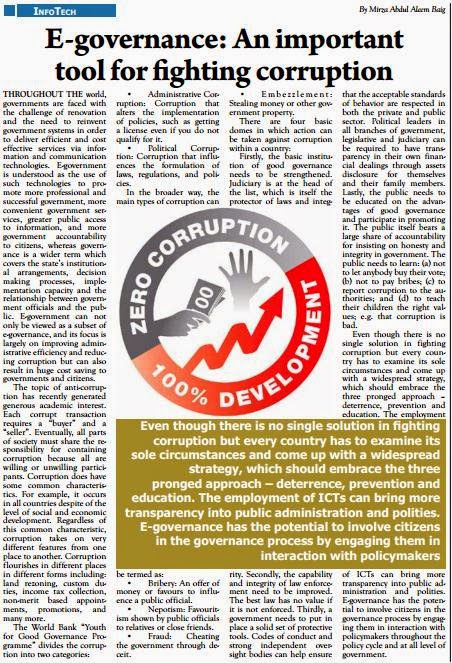
E-governance: An important tool for fighting corruption

Throughout the world, governments are faced with the challenge of renovation and the need to reinvent government systems in order to deliver efficient and cost effective services via information and communication technologies. E-government is understood as the use of such technologies to promote more professional and successful government, more convenient government services, greater public access to information, and more government accountability to citizens, whereas governance is a wider term which covers the state’s institutional arrangements, decision making processes, implementation capacity and the relationship between government officials and the public. E-government can not only be viewed as a subset of e-governance, and its focus is largely on improving administrative efficiency and reducing corruption but can also result in huge cost saving to governments and citizens.
The topic of anti-corruption has recently generated generous academic interest. Each corrupt transaction requires a “buyer” and a “seller”. Eventually, all parts of society must share the responsibility for containing corruption because all are willing or unwilling participants. Corruption does have some common characteristics. For example, it occurs in all countries despite of the level of social and economic development. Regardless of this common characteristic, corruption takes on very different features from one place to another. Corruption flourishes in different places in different forms including: land rezoning, custom duties, income tax collection, non-merit based appointments, promotions, and many more.
The World Bank “Youth for Good Governance Programme” divides the corruption into two categories:
• Administrative Corruption: Corruption that alters the implementation of policies, such as getting a license even if you do not qualify for it.
• Political Corruption: Corruption that influences the formulation of laws, regulations, and policies.
In the broader way, the main types of corruption can be termed as:
• Bribery: An offer of money or favours to influence a public official.
• Nepotism: Favouritism shown by public officials to relatives or close friends.
• Fraud: Cheating the government through deceit.
• Embezzlement: Stealing money or other government property.
There are four basic domes in which action can be taken against corruption within a country:
Firstly, the basic institution of good governance needs to be strengthened. Judiciary is at the head of the list, which is itself the protector of laws and integrity. Secondly, the capability and integrity of law enforcement need to be improved. The best law has no value if it is not enforced. Thirdly, a government needs to put in place a solid set of protective tools. Codes of conduct and strong independent oversight bodies can help ensure that the acceptable standards of behavior are respected in both the private and public sector. Political leaders in all branches of government, legislative and judiciary can be required to have transparency in their own financial dealings through assets disclosure for themselves and their family members. Lastly, the public needs to be educated on the advantages of good governance and participate in promoting it. The public itself bears a large share of accountability for insisting on honesty and integrity in government. The public needs to learn: (a) not to let anybody buy their vote; (b) not to pay bribes; (c) to report corruption to the authorities; and (d) to teach their children the right values; e.g. that corruption is bad.
Even though there is no single solution in fighting corruption but every country has to examine its sole circumstances and come up with a widespread strategy, which should embrace the three pronged approach – deterrence, prevention and education. The employment of ICTs can bring more transparency into public administration and polities. E-governance has the potential to involve citizens in the governance process by engaging them in interaction with policymakers throughout the policy cycle and at all level of government.


Corruption in health system: The scale of problem

Health is a most significant global industry but, more than that, it is a global human right. The health sector is susceptible to abuse through diverse channels. Health system integrates various different actors in a complex web of relationships, which makes corruption difficult to identify where it exists. Corruption in the health system is broadly known both in developed and developing countries but widespread corruption in Pakistan is disquieting. According to the Transparency International, corruption may be defined as “the misuse of entrusted power for private gain” or “sale by government officials of government property for private gain”.

Corruption in the health division is not exclusive to any particular kind of health system. It occurs in systems whether they are principally public or private, technically simple or sophisticated, and sound funded or badly funded. The degree of corruption is, in part, an indication of the society in which it operates. Health system corruption is less expected in societies where there is broad obedience to the rule of law, transparency and trust, and where public sector is ruled by effective civil service codes and strong accountability mechanism.

Corruption in the health system is an anxiety in all countries, but it is particularly serious problem in developing countries like Pakistan. The number of features of health system corruption can be identified that includes: financial leakages, fraud, illegal fees, theft of supplies and equipments, over-invoicing, clever book keeping, selling public positions and bribes, failure to base decisions on evidence, etc. According to the cross country survey by Transparency International, the public gauging perceptions of corruption in public service shows that 95% of the study population perceives that the health system is corrupt in Pakistan.

The overall impact of corruption in health system on society and on individuals can be wide-ranging. We can differentiate between direct and indirect impacts, for example, tangible (material, health quality) and intangible (social, psychological), short term (price and quality) and long term (health system) impacts. Corruption not only reduces the resources effectively available for health, lowers the quality, equity, and effectiveness of healthcare services, but also decreases the volume and increases the cost of provided services. The list demonstrates the overall impact of corruption in healthcare on the society and on individuals.

·         Impact on health budget: Corruption in health system may lead to a non-optimal allocation of health budgets;
·         Impact on price: Corruption in health system may lead to a provision of services or procurement of equipment and drugs at above market prices;
·         Impact on access to health: Corruption in health system may threaten the goal of universal health coverage because as the price of healthcare increases, the accessibility decreases;
·         Impact on health quality: Corruption in health system may lead to low quality in the provision of healthcare services and a low quality in the provision of medical devices and pharmaceuticals;
·         Impact on markets: Corruption in health system may lead to various market distortions such as bad doctors driving out good doctors, bed suppliers driving out good suppliers;
·         Indirect impact on society: Corruption in health system may cause productivity loss through bad health; distrust in provisions of services by the government; distrust in the health system; and distrust in society as a whole;
·         Cross-border impacts: Corruption in health system may lead to brain drain of medical personnel;


According to the study carried out by the International Monetary Fund (IMF) using data from 71 countries, shows that countries with high indices of corruption scientifically have higher rates of infant mortality. Reverting back to local setting, initially, preventing maltreatment and reducing corruption is a key to increase capital available for health, to make more efficient use of existing resources and, ultimately, to improve the general health status of the population. Before I finish, for promoting anti-corruption plan in Pakistan the government should ensure the law against corruption and the law should be enforced equally for everyone. An effective and efficient anti-corruption policy will result in great decline of corruption not only in health system but also all public sectors.

Monday, 7 July 2014

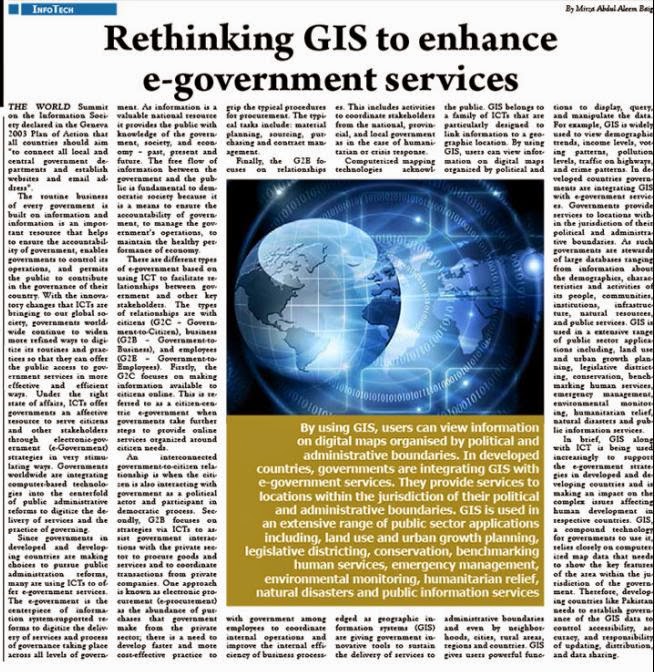
Rethinking GIS to enhance e-government services

The World Summit on the Information Society declared in the Geneva 2003 Plan of Action that all countries should aim “to connect all local and central government departments and establish websites and email address”.
GIS is used in a extensive range of public sector applications including, land use and urban growth planning, legislative districting, conservation, benchmarking human services, emergency management, environmental monitoring, humanitarian relief, natural disasters and public information services.
In brief, GIS along with ICT is being used increasingly to support the e-government strategies in developed and developing countries and is making an impact on the complex issues affecting human development in respective countries. GIS, a compound technology for governments to use it, relies closely on computerized map data that needs to show the key features of the area within the jurisdiction of the government.


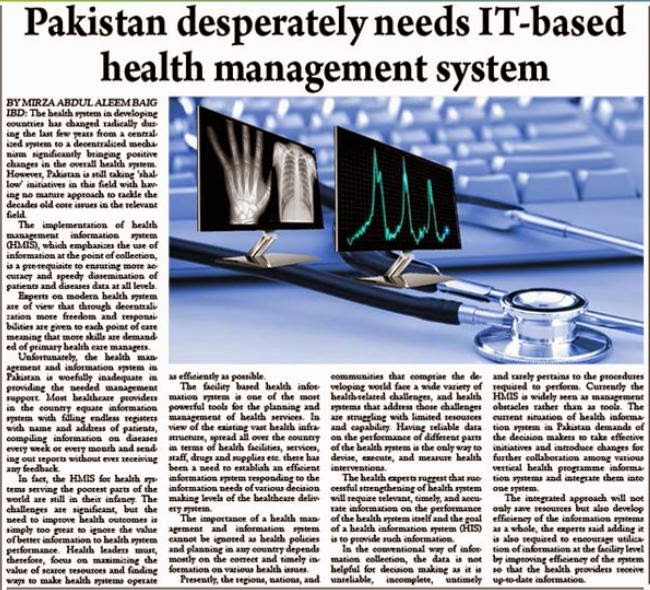
Pakistan desperately needs IT-based health management system

  • The facility based health information system is one of the most powerful tools for the planning and management of health services. In view of the existing vast health infrastructure, spread all over the country in terms of health facilities, services, staff, drugs and supplies etc. there has been a need to establish an efficient information system responding to the information needs of various decision making levels of the healthcare delivery system.
  • The importance of a health management and information system cannot be ignored as health policies and planning in any country depends mostly on the correct and timely information on various health issues.
http://www.technologytimes.pk/english-news.php?title=Pakistan%20desperately%20needs%20IT-based%20health%20management%20system

Health Informatics – a turning point in health system

The need for education in health informatics is accredited by most countries that are involved in the introduction of technology in healthcare. A number of developing countries have recently undertaken structural reform to the healthcare information and delivery system; an important component of this reform is the establishment of reliable, timely and effective information systems. Additionally, health informatics is also a key element of the practice of evidenced-based medical education, students with a web based medical education can study more resourcefully and make sound judgments regarding the clinical problems they encounter during their practical life. The curriculum adopted in the conventional medical institutes of developed and developing countries is replaced by a number of new teaching methods that improve dynamic learning but unfortunately we are still stuck to the old traditional methods of teaching based on lectures and memorization. Presently large numbers of private and public medical institutes in Pakistan are still teaching by traditional methods whereas most of the medical institutes in the developed world are training their future physicians by latest teaching tools like evidenced-based and problem-based learning. Since health information and information management is not generally documented in Pakistan and this area has not been given the due attention among the health profession thus, it is essential that health informatics be considered as a tool for better healthcare and health system management and be promoted through education and training and introduction of health informatics in the health and biomedical education is of prime importance.
http://technologytimes.pk/english-news.php?title=Health%20Informatics%20%E2%80%93%20a%20turning%20point%20in%20health%20system

HIT: Fuelling decision, saving lives!

The deliverance of healthcare is changing globally. Policymakers, healthcare providers, supporting industries, and payers all are playing a significant function in the revolution of healthcare from the existing reactive mold to one that is personalized, predictive, preventive, and participatory. The union of systems’ loom to sickness, biomedical technology, imaging technology, and health information technology tools are building a learning healthcare system that applies healthy evidence-based medicine to manage optimal healthcare. An improved capability to recognize symptoms and risk factors, together with larger data capacity, has given a greater insight into the nature of many diseases.

Sunday, 26 May 2013

Electronic Health Records for improved healthcare!

In the present days, healthcare is characterized by a continuous decision-making process, that requires timely and secure access to complete, accurate, and up-to-date patient information, as well as to the accumulated wide-ranging body of medical knowledge. The most essential aspect of this need is the modern national initiative to develop and implement Electronic Health Records (EHRs). 


  • Electronic health records and data sharing will not only improve quality of health, reduce costs, and decrease medical errors but also give immediacy and accessibility to healthcare providers, which is a significant benefit for the patients. Adoption of electronic health record systems are critical and necessary components for advance healthcare, and EHR systems are the fundamental building blocks for any national health information system.

Wednesday, 8 May 2013

Informatics: An inventive approach for optimal healthcare!

Development of efficient health information systems requires understanding of medical informatics, the systematic application of information and computer science technology to health practice, research and learning. Medical informatics is the swiftly growing scientific field that bond with resources, devices, and formalized methods for optimizing the storage, retrieval and management of biomedical information for problem solving and decision making.


m-health and the future of healthcare

According to the World Health Organization (WHO), among 57 countries, generally in the developing countries, there is a serious shortage in healthcare workers, representing a total deficit of 2.4 million healthcare workers worldwide. WHO Health specialists note that within the next 10 to 15 years, policymakers and health providers in developing countries will be enforced to turn their focus to prevention and early detection rather than late-stage treatment of non-communicable diseases. This gap produces a foreseeable interventional role for mobile technology for health. Mobile for health – m-Health broadly encompasses the use of mobile telecommunication and multimedia technologies in healthcare delivery systems. A definition used at the 2010 m-Health Summit of the Foundation for the National Institutes of Health (FNIH) was “the delivery of healthcare services via mobile communication devices”.

http://technologytimes.pk/documents/mag/2013/03%20March/Issue_04-09/Page_03.html

ICT for sustainable democracy and good governance

“The constitution is not an instrument for the government to restrain the people; it is an instrument for the people to restrain the government – lest it come to dominate our lives and interests.” – Patrick Henry 
In democracy, the State is the servant of the people. It executes many functions essential for the wellbeing and development of its citizens and provides an array of essential services. ICT makes it possible for government and citizens to connect each other and to introduce government transparency and accountability, thus giving citizens the ability to participate in a way that makes representative democracy more effective and accessible. In the 21st century and in the age of information technology government must be efficient, effective, participative, honest, transparent, professional, responsive, and collaborative if they desire to achieve the goals of socially equitable economic growth and sustainable human development. The Government of Pakistan must not only play a critical role in the development of the on-line world but also need to incorporate and adapt policies and technologies that will expand participatory democracy.

http://www.technologytimes.pk/documents/mag/2013/01%20January/Issue_04-05/Page_02.html