The deliverance of healthcare is changing globally. Policymakers, healthcare providers, supporting industries, and payers all are playing a significant function in the revolution of healthcare from the existing reactive mold to one that is personalized, predictive, preventive, and participatory. The union of systems’ loom to sickness, biomedical technology, imaging technology, and health information technology tools are building a learning healthcare system that applies healthy evidence-based medicine to manage optimal healthcare. An improved capability to recognize symptoms and risk factors, together with larger data capacity, has given a greater insight into the nature of many diseases.
Monday, 7 July 2014
Sunday, 26 May 2013
Electronic Health Records for improved healthcare!
In the present days, healthcare is characterized by a continuous decision-making process, that requires timely and secure access to complete, accurate, and up-to-date patient information, as well as to the accumulated wide-ranging body of medical knowledge. The most essential aspect of this need is the modern national initiative to develop and implement Electronic Health Records (EHRs).
- Electronic health records and data sharing will not only improve quality of health, reduce costs, and decrease medical errors but also give immediacy and accessibility to healthcare providers, which is a significant benefit for the patients. Adoption of electronic health record systems are critical and necessary components for advance healthcare, and EHR systems are the fundamental building blocks for any national health information system.
Wednesday, 8 May 2013
Informatics: An inventive approach for optimal healthcare!
Development of efficient health information systems requires understanding of medical informatics, the systematic application of information and computer science technology to health practice, research and learning. Medical informatics is the swiftly growing scientific field that bond with resources, devices, and formalized methods for optimizing the storage, retrieval and management of biomedical information for problem solving and decision making.
m-health and the future of healthcare
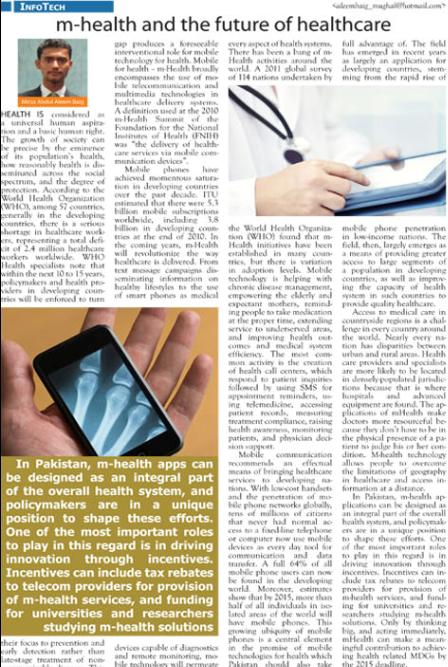
According to the World Health Organization (WHO), among 57 countries, generally in the developing countries, there is a serious shortage in healthcare workers, representing a total deficit of 2.4 million healthcare workers worldwide. WHO Health specialists note that within the next 10 to 15 years, policymakers and health providers in developing countries will be enforced to turn their focus to prevention and early detection rather than late-stage treatment of non-communicable diseases. This gap produces a foreseeable interventional role for mobile technology for health. Mobile for health – m-Health broadly encompasses the use of mobile telecommunication and multimedia technologies in healthcare delivery systems. A definition used at the 2010 m-Health Summit of the Foundation for the National Institutes of Health (FNIH) was “the delivery of healthcare services via mobile communication devices”.
http://technologytimes.pk/documents/mag/2013/03%20March/Issue_04-09/Page_03.html
ICT for sustainable democracy and good governance
“The constitution is not an instrument for the government to restrain the people; it is an instrument for the people to restrain the government – lest it come to dominate our lives and interests.” – Patrick Henry
In democracy, the State is the servant of the people. It executes many functions essential for the wellbeing and development of its citizens and provides an array of essential services. ICT makes it possible for government and citizens to connect each other and to introduce government transparency and accountability, thus giving citizens the ability to participate in a way that makes representative democracy more effective and accessible. In the 21st century and in the age of information technology government must be efficient, effective, participative, honest, transparent, professional, responsive, and collaborative if they desire to achieve the goals of socially equitable economic growth and sustainable human development. The Government of Pakistan must not only play a critical role in the development of the on-line world but also need to incorporate and adapt policies and technologies that will expand participatory democracy.
http://www.technologytimes.pk/documents/mag/2013/01%20January/Issue_04-05/Page_02.html
Wednesday, 9 January 2013
Mobile technology for health: A look to developing nations
Developing countries endure from pervasive health troubles that are less frequent or nonexistent in developed countries. In recent years the bulk of global attention to health has focused on communicable diseases, particularly the effort to meet the Millennium Development Goal (MDG) of controlling HIV/AIDS, malaria, and tuberculosis by 2015. Subsequently, developing countries have heavy burdens of health problems due to idiosyncratic events. When natural disasters occur, these countries are often not operational to compact with the resulting health emergencies. In this regards, mobile applications can play a pivotal role in identifying areas of greatest need, targeting services, and maintaining public awareness in emergency situations and after crises. In Pakistan, the national healthcare system is still struggling to deliver affordable access to healthcare to all citizens. Despite the potential it holds, m-health deployment is presently narrow in the country. Imperative actions are therefore needed to break down barriers to the widespread adoption of mobile technology in healthcare and, most urgently are the need to increase knowledge and awareness of the potential impact of m-health among healthcare organizations, patients, and other stakeholders in country. M-health has the potential to revolutionize the delivery of healthcare in Pakistan.
2013 New Year Resolution: What’s your plan??? | The News Tribe Blogs
Watch your thoughts, for they become words,Watch your words, for they become actions,Watch your actions, for they becomes habits,Watch your habits, for they become character,Watch your character, for it becomes your destiny.
E-Democracy: Isn’t it a key to cease corruption? | The News Tribe Blogs
“The real difference between democracy and oligarchy is poverty and wealth. Whenever men rule by reason of their wealth, whether they be few of many, that is an oligarchy, and where the poor rule, that is democracy” – Aristotle
Presently, Pakistan has a democratic system without democrats and it is hijacked by a small group of feudal lords, political elites, bureaucrats and organizations under foreign influence. Most of the time, democratic election only commit to reshuffling of the same old faces.Saturday, 24 November 2012
Modern medical ethics: Critical issue for 21th century | The News Tribe Blogs
“If we believe men have any personal
rights at all as human beings, they have an absolute right to such a measure of
good health as society, and society alone is able to give them” – Aristotle
Health systems as defined by World
Health Organization (WHO) “all the activities whose primary purpose is to
promote, restore or maintain health”. When we move into the 21st
century, the promotion and protection of human rights is gaining greater
momentum. The WHO constitution 1946 stated “The
enjoyment of the highest standard of health is one of the fundamental rights of
every human being without distinction of race, religion, political belief,
economic or social condition”
Patients, families and healthcare
professionals occasionally face complicated decisions about medical treatments.
These decisions may clash with a patient and/or family morals, religious
beliefs or healthcare plan. In this risky situation medical ethics is not only considerate
review of how to act in the best interest of patients and their family but also
about making good choices based on beliefs and values regarding life, health, and
suffering. In the past, only a few individual physicians devoted themselves to
medical ethics. Beginning in the second half of twentieth century, the field
undergoes explosive expansion and experts from numerous disciplines entered in
medical ethics. The swift advances in medical diagnosis and treatment and the
introduction of new technologies have created numerous new ethical problems,
resulting in the maturation of medical ethics as a specialty in its own right.
Enormous development has been achieved
in the medical field during the last few decades and more is projected in the
following decades. Advances in diagnostic imaging and biological testing
techniques as well as in medical forecasting based on genetic testing are ongoing.
Advances in surgical and medical cures, organ and tissue transplantation,
artificial organs, cloning, tissue culture techniques, molecular biology and
information technology are reported almost daily. “Modern Medical Ethics” is
based on concept derived from various disciplines, including the biomedical
sciences, the behavioral sciences, philosophy, religion and law. Modern medical
ethics is essentially a form of applied ethics, which seeks to clarify ethical
questions that characterize the practice of medicine and to justify and weigh
the various practical options and considerations. Thus medical ethics is the
application general ethical principles to ethical issues. The application of
such an ethic is not specific to medicine but also relates to economy, law,
journalism, and their like.
Medical ethics is now not only part of
the curriculum in institutes of the health professions in developed countries
but also research institutes of medical ethics have been established at all
levels. In developed nations the medical literature has proliferated, with
numerous books and journals devoted entirely to the subject. In such countries
common citizen is also vitally interested in this subject, and public lectures,
newspaper articles, legal discussions and legislation on medical ethical issues
are frequent. Within Canada, EU, United States, and somehow gulf countries,
Modern Medical Ethics has emerged as a new professional. The individuals normally
have specialized in one or more the fields of philosophy, ethics, law, religion
and medicine, and serve as advisor in hospitals to physicians, patients and
their families. They also effort to resolve difficult ethical questions posed
to them by the medical team or by patients and their families.
Monday, 19 November 2012
3S tech – implementation for disaster management in developing countries!
Disaster whether natural or man-made play wreckage role with the live of millions of people every year around the globe. Their aftermath is nothing but a harsh picture of destruction, death, and misery. Today it is proven truth that natural disaster can happen at any place irrespective of the developed, developing or the least developed status of a country and it is also experienced that the least developed and developing countries are impacted more severely by large scale natural disasters. It is not always possible to avoid disaster but the sufferings can be reduced by appropriate disaster management through proper disaster management tools. The advancement in Information and Communication Technology in the form of GIS, Remote Sensing, Space Technology etc, can help a great deal in planning and implementation of disaster reduction procedures.
Space-based ICT applications are playing an explicit role in providing information, information services and decision support tools for disaster management in developed regions of the globe. Procedures such as continuous information acquisition over a broad geographic area, as well as distribution of information services and applications to remote and less serviced areas, chiefly promote from this technology. The rapid development of space-based ICT and the integration of remote sensing, Geographic Information System (GIS), and satellite position system, collectively known as 3S technology, have created a solid foundation for effective disaster information and monitoring management in developed world. 3S technology functions have being extensively utilized in two broad areas of disaster management. The initial deals with uplifting awareness, and includes preparations and planning to decrease vulnerabilities while, among other things, an understanding of the process, modeling, monitoring, early warning systems, forecasting, and hazards risk mapping.
As declared by United Nations Development
Programme (UNDP), 24 out of 49 least developed countries, most of which are in
Asia and the Pacific, face high levels of disaster risk, therefore the technology
that is enabled by satellites holds great potential to meet significant needs
in developing countries. Specially, satellite-based remote sensing,
communication and navigation capabilities can provide valuable services in the
developing world. Unfortunately, the potential of these technologies is not
fully met due to different obstacles that prevent developing countries from
making use of such technology. These barriers include lake of access of
funding, expertise, infrastructure, equipment and education. According to
research done with the International Telecommunication Union (ITU) has proven
that an investment of $1 in ICTs used for disaster management through
monitoring and response could save $14-$22 for rehabilitation after the
disaster.
In
recent years Pakistan has suffered a series of natural disasters, including the
2005 earthquake and floods in 2010 and 2011. These calamities killed thousands
of citizen and cost millions by destroying large-scale infrastructure, housing,
live-stoke, agriculture and other assets. Since Pakistan is situated on major
earthquake fault lines, the likelihood of similar tragedies in the future
remains significant. Pakistan still lack in a systematic and organized approach
towards managing the effects of natural disasters. However, the National
Disaster Management Authority (NDMA) which is the executive arm of the National
Disaster Management Commission (NDMC) headed by Prime Minister, has been
assigned the task of coordinating the disaster risk management at the national
level, implementing disaster risk management strategies, mapping the hazards,
developing guidelines and ensuring the establishment of Emergency Operation
Centers (EOCs) at provincial, district and municipal levels. Despite
establishment of this organization assigned with apparently various tasks,
disasters in Pakistan are barely managed efficiently. According to the
government, a lot of work is under way but, the last budget couldn’t allocate
significant money for IT or telecommunication sector to build efficient
disaster management structure to overcome the natural disasters. Keeping the
current ICT infrastructure of the country in mind, especially in the rural
areas, such digital rescue operation is a myth, away from reality.
In
the light of above facts, it is obvious that Pakistan is in ominous need of an
organized disaster management programme to face the emergency situations.
Government of Pakistan must reinforce its disaster management policies and build
up institutions to not only tackle such situations but also make them best use.
It is high time that the government as well as citizen of Pakistan play their
own respective role to bring about a positive change!
“A
nation that continues year after year to spend more money on military defense
than on programs of social uplift is approaching spiritual doom”. – Martin
Luther King Jr.
ICT in education: Transforming the learning environment
“Those who know cannot be like
the ones who do not know. Of course, knowledge and ignorance are like light and
darkness which can never be alike” – Holy Quran
Education is the most important aspect
that plays a principal role in human development. It endorses a productive and
informed citizenry and creates opportunities for the socially and economically deprived
segment of society. The development of a nation depends on its system of
education, as it develops capacities in the individuals and enhances
inner-strengths – intellectual, political, social and economic against, domination,
exclusion and discrimination. Educational development occupies an important
place at the apex of the all development segment pyramid and helps to develop
the cream of the society – a selected group of individuals – physically,
intellectually, emotionally and socially.
“There is no doubt that the
future of our State (Pakistan) will and must greatly depend on the type of
education we give to our children and the way in which we bring up as future
citizens of Pakistan” – Quaid-e-Azam Muhammad Ali Jinnah (All Pakistan Education
Conference, Karachi)
Education is a dynamic process.
Every human being is born with talents. Education exploits these talents in a healthy,
integrated and balanced manner. According to the UNESCO Commission on Education
“educational institutions are a decisive factor in training men to contribute
to the development of the society, to play an active part in life and in
properly preparing men for work”. Therefore, spread of education is a sin qua
non both for modernization and sustenance of democracy and also to make man “be
himself” and “to become himself” (UNESCO, 1979).
Innovation in science and
technology is transforming the world at an astonishing rate. Development in
computing and communication, in particular, are helping to accelerate these
challenges. As we move into 21st century, we observe ICT has changed many
aspects of the way we live. If anyone tends to compare such fields like banking,
business, engineering, medicine, tourism, law, the impact of ICT across the
past two or three decades has been enormous. The way these fields function
today is enormously different from the ways they operated in the past. In
recent years many hypothetical and practical efforts have also been made to
assess the impact of ICT on educational reform process for both access of education
and quality of education because, among all the development sector education
sector is primarily the most attentive sector connects to improve the
efficiency, accessibility and quality of the learning process.
People in present society are
becoming more and more familiar with ICT as ICT refers to ‘the technology that
enables communication and transmission of information’. When implementing the
ICT in the education sector, there are considerable challenges such as cost,
internet access, training and policy issue, and each issue has its own ways of
addressing which is valuable to apply around world. However, all these
challenges for development through applying ICT to the education sector must
consider the environment that each country faces, because the situation of each
nation is totally different from each other. ICT can transform the learning
environment in the following ways:
ü
Active learning: ICT can increase learning
mobilization tools for examination, calculation and analysis of information,
thus can offer a platform for student inquiry, analysis and construction of new
information.
ü
Collaborative learning: ICT can support learners through
interaction and cooperation among students, teachers, and experts regardless of
where they are. It can also provide opportunity to work with people from
different cultures.
ü
Evaluative learning: ICT can permit learners to explore
and discover rather than merely listen and remember and it can recognize that
there are many different learning pathways and many different articulations of
knowledge.
Consequence of education for
human development does not need any clarification. For developing countries
like Pakistan ICTs have the potential for increasing access to and improving
the relevance and quality of education. Government of Pakistan accepts
education as the fundamental right for its citizens, yet it has an unimpressive
track record of provision of literacy at the grass-root level. Consequently, the
reality of the Digital Divide – the gap between those who have access of
technology and those who do not – means that the prologue and inclusion of ICTs
at different levels and in various types of education will be most challenging activity.
Failure to meet the challenge would mean a further widening of the knowledge gap
and the deepening of existing economic and social inequalities between the
developed and developing world.
“If you treat an individual as if
he were what he ought to be, and could be, he will become what he ought to be
and could be.” – Johann Wolfgang Von Goethe
Technology transfer – an approach for national progress
The rapid expansion of science and technology started
about three hundred years ago in seventeenth century. Since then science has
built up an extensive body of knowledge about the world and about the history
of man, the earth, the solar system and the universe. Science and technology
are crucial to the development prospects of developing countries in two different
ways. First, science and technology can provide tools that help alleviate the
specific problems that afflict many poor countries and delay their development
prospects, such as disease, lake of infrastructure (information, transport,
energy, etc.). Second, science and technology are central to the dynamics of
economic development itself. Economically successful countries are those that
are able to turn technical innovation into economic productivity. Successful
technology transfer from developed countries to developing countries can
improve the live and economic growth as technology transfer is the process of
sharing of knowledge, skills, methods of manufacturing, samples of
manufacturing and facilities among governments and accessible to a wider range
of users who can then further develop and exploit technology. At the same time,
technology transfer is not a process that characterizes a stage in the
development of the Third world but, it occurs constantly in the First World
as-well. In theory, technology transfer is closely related to the diffusion of
innovations.
The
inclination of developed countries to facilitate access to and transfer of
technology to developing countries is reflected in a number of international
agreements. These agreements identify that technology transfer to developing
countries is important to facilitate their integration into the global economy,
and meet their international obligations and commitments. They also recognize
that technology transfer is important in facilitating the creation of a sound
and viable technological base in developing countries. Since the time of
independence in 1947, science and technology in Pakistan has seen many ups and
downs throughout its history because Pakistan inherited very few folks those
were capable of scientific development and technological research. But, in the
past few decades, Pakistan has made noticeable progress in technological
development. The existing institutional skeleton for Science and Technology in
Pakistan comprises governmental and non-governmental institutions. In 1964, the
Scientific and Technological Research Division was established for coordination
and implementation of national science and technology policy, and to promotion
of research and utilization of the results for coordination of utilization of
scientific and technological manpower.
Technology
transfer is an important issue and key component of economic and social
development of developing nations. The successful implementation of technology
depends not only on good technical specifications, but also on the right
social, political, and institutional environment. The existing type and
capacity of educational institutes in developing countries are not sufficient. Educational
institutions in developing countries should be provided with modern computer
and information technologies (ICT) facilities to enable hands-on practical
training and special attention should also be paid to on-the-job training. The
training of technologists and operators which forms the basis for the
implementation of a new technology has to be given a high priority.
It
is obvious that the technology transfer from the developed countries to
developing countries is not a straightforward mechanism. Keeping in view the
importance of problems relevant to the technology transfer, many developing
countries have established institutions for public support. The situation
demands that the government of Pakistan must establish institutions, with
proper technical manpower to deal with the problems relevant to foreign
technology transfer. The institutions may facilitate the local industry and other
technology users in the following ways:
·
Locating
the proper information sources of foreign technologies.
·
Facilitating
industrial sector in pricing the international technology.
·
Establishing
a complete coordination between technology venders and users.
·
Conducting
research studies for technology transfer in various sectors.
·
Making
proper arrangements for assessment and evaluation of technology in terms of its
effect on environment and society.
On
the basis of above arguments it is important that for successful technology
transfer there is an urgent need for the establishment of some institutions
with appropriate policy across Pakistan to deal with various aspects of
technology transfer to maintain scientific growth in country.
Health ICT towards the millennium development goals
"The implementation of health ICTs in developing countries particularly Pakistan has been hampered by traditional obstacles like poor infrastructure, lack of resources, and insufficient political commitment and support. This can be appropriately summarized as follows, as the “Four Cs” – connectivity, cost, capacity, and culture. Presently, the problem of improving health-care delivery in developing countries is more about the impartial distribution of available resources to all areas of the health system than about technology. Technologies exist that would help doctors working in isolated rural villages to access to up-to-date medical information and communicate with colleagues, and even to diagnose illnesses and treat patients".
Saturday, 10 November 2012
Radiology – the future of diagnosis and treatment | The News Tribe Blogs
The
international imaging community is organizing International Day of Radiology
(IDoR) on Thursday 8th November 2012 to raise awareness of the value
of radiology to safe patient care, and to improve understanding of the vital
role of radiologists in the healthcare practice. The purpose of this day is to increase
knowledge of radiographic imaging and therapy, which play a crucial role in
diagnosis and treatment of patients. World Radiology Day marks the anniversary
of the discovery of X-rays in 1895, on this day Professor Wilhelm Roentgen
discovered X-rays and within three months of discovery radiographs were
generated in major cities. In honor of his discovery, the European Society of
Radiology (ESR) along with the Radiological Society of North America (RSNA) and
American College of Radiology (ACR) decided 8th November should be
marked yearly with a devoted day of observance.
Medical
imaging is one of the most thrilling and progressive discipline in healthcare
and a field of great activities in terms of technological and biological
research. Early radiology was embedded in morphology, namely skeletal
morphology. The change towards image of physiology of the human body began with
radiology and nuclear medicine. In the midst of the excitement brought about by
the Roentgen’s discovery, Becquerel discovered radioactivity in the early 1896.
Similar to the discovery of x-rays, phosphorescence was accidental thus, began
the dawn of the medical imaging age. Subsequently, numerous scientists for
instance Curies and Rutherford had contributed to the advancement of radiology.
Thus, the use of single-photon emission computed tomography (SPECT) and to a
greater extent positron emission tomography (PET) to display functional
abnormalities not detected by other imaging tools have made assessment of
treatment practicable.
In
the early years, radiographs were initially made onto glass photographic plates
which were coated with emulsion only on one side. In 1918, Eastman introduced
film coated with emulsion on two surfaces. Radiograph at this time was focused
on imaging of extremities, mainly to detect fractures and to localize position
of bullets. Further development brought about an intravenous contrast agent
marketed for urinary tract radiograph in 1927. The next development involved
the use of fluorescent screen, an x-ray tube, and x-ray table and red goggles
and required the radiologist to stare directly into the screen so that x-ray
images could be displayed in real time. This was a rather primitive method as
the fluorescence emitted was very dim. The iodine-based contrast arteriogram in
a patient was reported in 1929 by Dos Santos, more or less 34 years after the
discovery of x-ray. In the late 1980’s and early 1990’s however, two essential
technologies have greatly impacted the evolution of angiography; moveable
multiple-angle C-arm fluoroscopy and digital image acquisition. By the 1970’s
ultrasound (US) and computed tomography (CT) had arrived displacing angiography
as the supreme imaging tool in radiology. By the 1990’s duplex ultrasound, CT
angiography and Magnetic Resonance (MR) angiography began to replace diagnostic
arteriography for the direct study of vascular pathology. In most radiology departments
today, catheter-based angiography is reserved mainly for diagnosis of
atherosclerotic vessels and as an adjunct to interventional procedure. The
emergence of three powerhouses imaging tools namely ultrasound, computed
tomography and magnetic resonance imaging have revolutionized the care of
patients across the continuum of medicine and surgery.
Radiology
is now often referred to as ‘imaging’ reflecting the fact that it is no longer
dependant on x-rays alone. Over the years, ultrasound has stood the test of
time proving to be a safe, reliable, portable and cheap imaging modality. In
1972 the cross-sectional imaging became a catch phrase; this was attributed to
the invention of computed tomography. The earliest CT scanners were limited to
imaging of the head, by 1976 the technology had evolved to whole body scanners,
and by the 1980’s CT Scans had gained worldwide acceptance. Today there are an
estimated 600,000 locations around the world where this diagnostic tool is in
use. The prototype CT Scanners took roughly four minutes of lapsed time to
acquire a single image. Currently, modern units produce images in less than 0.5
seconds. The advent of CT had an enormous effect on our ability to ‘SEE’ inside
the body and immediately changed the practice of medicine; the momentum created
by CT scanners fueled the commercial development of MRI systems. In its
infancy, many thought that MRI would have a limited impact because of its high
cost, the technical difficulties associated with it and the belief the CT
scanning was a superior method of imaging. MRI has quickly become the primary
imaging method for brain and spine imaging as well as functional imaging of the
heart.
Computers
and the digital world have impacted the science of Radiology bringing it to what
it is today. The advancement of artificial intelligence in the last 25 years
has created an explosion of diagnostic imaging technique. These techniques have
now been developed for digital rather than photographic recording of
conventional radiographs. In the early days, a head X-ray would require up to
11 minutes of exposure time but now digital radiographic images are made in
milliseconds while reducing the radiation dose to as little as 2% of what was
used for the 11 minutes head examination 10 years ago. The resolution
achievable by the different imaging methods may be classified as spatial,
contrast or temporal. Spatial resolution is the ability of a system to resolved
anatomic detail. Contrast resolution is the ability of the system to
differentiate different tissue especially to distinguished normal from
pathological tissue. Temporal resolution is the ability of the modality to
reflect either changing physiological events such as cardiac motion or disease
remission or progression as a function of time. Each imaging modality has its
strength and weaknesses much to frustration of hospital administrators no
single method will solve all diagnostic problems and the fusion of knowledge
gleaned from different modalities would serve our patient best.
Medical Tourism: Patients beyond the Borders | The News Tribe Blogs
"Medical tourism has grown in a number of countries but, the main region is Asian countries such as Thailand, India, Malaysia and Singapore. Medical tourists not surprisingly are mainly from rich world countries where costs of medical care may be very high, and where the ability to pay for alternatives is also high. American, European and Canadian patients favor India, Thailand and Malaysia. India ranks second in the world in medical tourism, with Thailand leading the pack".
Subscribe to:
Posts (Atom)
-
http://www.diplomacypakistan.com/articles/gis-for-national-security-and-counterterrorism-strategy/ At least for the last three decade...
-
Overview: “Human organ can either be donated as free (gift) or sold by the donor. The organ could be accepted/purchased directly by a patie...
-
T he convergence of information and communication technologies (ICT) for improving health system through telemedicine addresses bot...